Going Out the Way the Forest Does: A Straight-Talking Guide to Green Burial
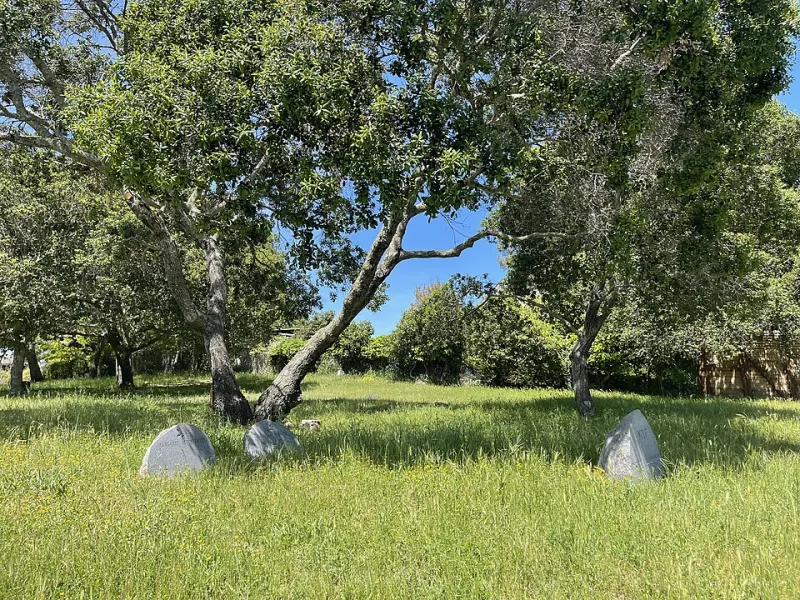
Photo: Missvain, CC BY 4.0, via Wikimedia Commons
There's a meadow in upstate New York where the headstones are wildflowers and the graves are mapped with GPS instead of granite. Families hike in. There's no vault, no concrete liner, no turf grass to mow, no irrigation. The land is held in trust, permanently, as habitat — and the people buried there are, functionally, part of the restoration plan.
That's a conservation burial ground. There are a growing number of them in the United States, and a lot of ordinary families are quietly choosing that option over the funeral home package their parents bought.
What "green burial" actually means
Strip away the marketing and the definition is narrow. Natural burial generally means: no embalming (or formaldehyde-free preparation), no concrete vault, no metal casket, a biodegradable container or shroud, and a grave dug shallow enough that the body returns to soil relatively quickly. The surface is planted with natives rather than seeded with lawn.
The Green Burial Council, a nonprofit that certifies providers, sorts grounds into tiers — hybrid cemeteries that offer a natural section alongside conventional plots, natural burial grounds, and conservation burial grounds, where the burial operation is legally tied to land protection. That last tier is the one with the real ecological payoff: your plot fee funds stewardship in perpetuity, and the easement usually prevents the land from ever being developed.
The price nobody quotes you up front
Here's the part the brochures leave out of the glossy spread: a conventional American funeral with viewing and burial has a median cost north of $8,000 for funeral home services alone. Add the cemetery plot, the vault, the opening and closing fees, and a marker, and plenty of families clear $12,000 without trying.
Natural burial at a typical green cemetery often lands in the $2,000 to $6,000 range, depending on region and whether you're buying a plot in a conservation ground. Human composting, where it's legal, runs roughly $4,000 to $7,000. A home funeral — washing and laying out a family member yourself, which is legal in most states — can bring the total down further, though it's not for everyone and it's a lot of work in a hard week.
None of that is a pitch for the cheapest option. It's a reminder that you're allowed to ask for prices before you're grieving, and that the expensive version isn't automatically the respectful one.
The legal stuff, briefly
Two myths worth killing. First: embalming is not required by law in any state for every death. Some states require it in specific circumstances, and individual funeral homes may push it as policy — those are different things. Second: you do not have to buy a casket from the funeral home. Under the FTC's Funeral Rule, if you show up in person you're entitled to an itemized general price list, and you can decline packaged bundles and supply a third-party casket or urn.
What does vary by state is home burial, vault requirements (often a cemetery rule rather than a statute), and who has legal authority over disposition. Many states now let you name an agent for disposition in writing — a genuinely useful document if you suspect your family will argue.
Where it's allowed
Natural burial in some form is available in essentially every state, often through a hybrid cemetery. Human composting is the newer frontier: Washington legalized it first, followed by Colorado, Oregon, Vermont, California, New York, Nevada and a handful of others — a little over a dozen states and counting as of this year, with legislation introduced in more each session. If composting appeals to you, check your state's current status before you make plans; this map moves.
Conservation cemeteries are the interesting part
If you care about the land, ask a green cemetery one question: who is legally responsible for this meadow in fifty years, and what stops it from becoming a subdivision? A real conservation ground will have an easement held by a land trust and an endowed stewardship fund. A cemetery with good intentions and no binding protection is a different thing entirely.
How to plan without getting sold a bill of goods
Have the conversation early, ideally over a kitchen table and not in a funeral home's arrangement room. Ask for the itemized price list. Write down who decides what happens to your body, and give a copy to that person. Be cautious about prepaying directly to a funeral provider — a payable-on-death account earmarked for funeral costs gives you more flexibility, and prepaid funeral contracts are regulated differently from state to state.
Then go outside. Visit the ground in person, in the season you're least likely to visit it. Walk the section. Ask where the drainage goes. It's a purchase like any other, minus the salesman's tie.
An honest accounting
The green burial movement's biggest win isn't carbon math — it's land. Conservation grounds protect habitat permanently, and they avoid the roughly 4 million gallons of embalming fluid buried in US soil each year. But it isn't zero impact. Cremation uses real energy, and it does emit mercury from older dental fillings; natural burial still involves transport and grave digging, and some grounds are more lawn than meadow.
What green burial offers is a different shape of death: less industrial, more local, and pointed back toward the living world instead of away from it. In a country that has spent a century landscaping its cemeteries to look nothing like nature, that's not a small thing.