Ditch the Grass: How Turning Your Lawn Into a Native Plant Garden Becomes Your Most Powerful Climate Act
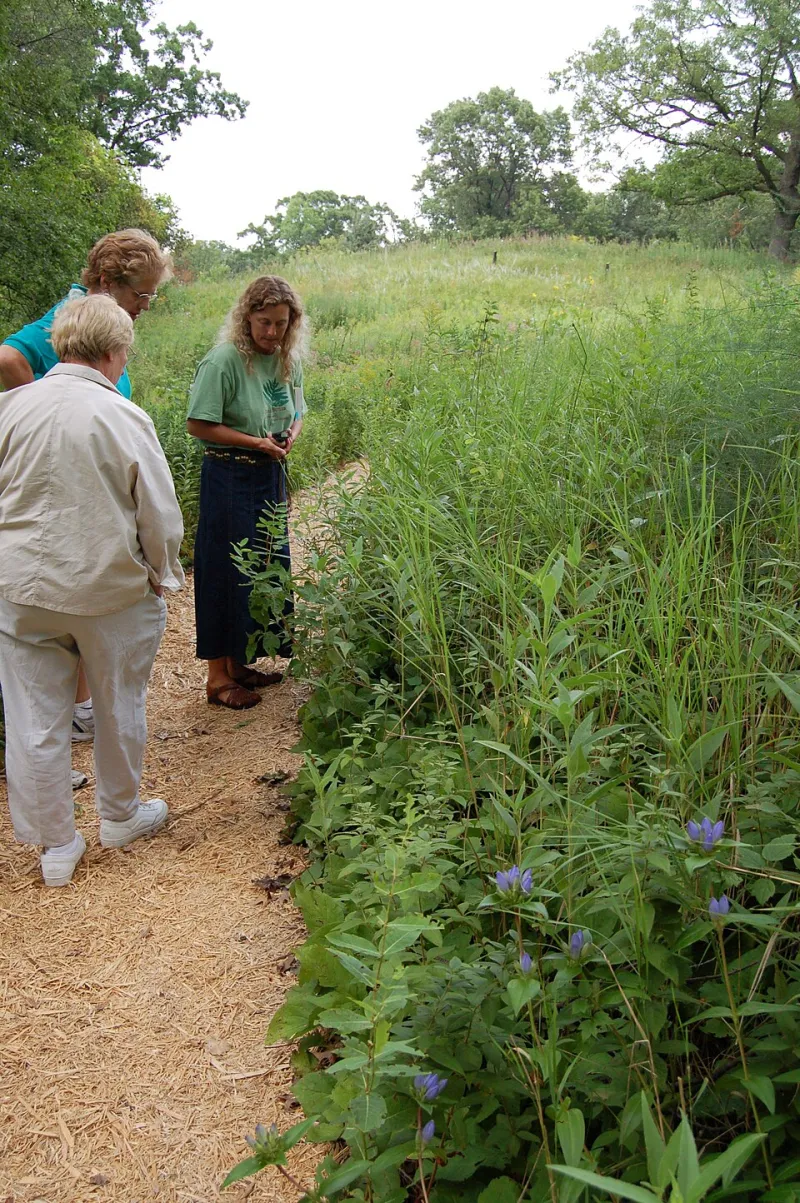
Photo: A. E. Crane, U.S. Department of Transportation, Public domain, via Wikimedia Commons
There's something almost hypnotic about a perfectly green, uniformly cut lawn. It signals order, care, prosperity. It's baked into the American suburban dream so deeply that most of us never stop to ask a very basic question: why?
Because here's what that dream actually costs us. The US has approximately 40 million acres of lawn — more than any single irrigated crop in the country. Maintaining it consumes 3 trillion gallons of water per year, 200 million gallons of gas for mowing, and 70 million pounds of pesticides and herbicides annually. Lawn mowers alone account for 5% of US air pollution. And after all that resource extraction? You get a monoculture that supports almost no wildlife, sequesters minimal carbon, and requires constant chemical intervention just to stay alive.
Native plant landscaping flips this entire equation. And it's one of the most accessible, tangible climate actions available to anyone who has a yard, a balcony, or even a strip of dirt alongside a sidewalk.
Why Native Plants Are Climate Powerhouses
Native plants — species that evolved in a particular region over thousands of years — have developed deep, complex relationships with local soils, rainfall patterns, insects, birds, and fungi. When you plant natives, you're not just adding greenery. You're restoring ecological infrastructure.
Deep-rooted native prairie plants, for example, can send roots 10 to 15 feet into the ground. That's not just impressive — it's carbon storage happening right in your backyard. Those roots sequester carbon in the soil far more effectively than the shallow root systems of turf grass. They also dramatically improve soil structure, allowing rainwater to percolate down rather than run off across pavement into storm drains (taking fertilizer and pesticide residue with it).
Native plants also require dramatically less water once established — typically none beyond natural rainfall after the first year or two. No irrigation systems. No sprinklers running at 6 AM. In drought-prone regions like the Southwest, this isn't just environmentally responsible — it's increasingly necessary.
And then there's the pollinator piece, which cannot be overstated. North America has lost more than 30% of its honeybee colonies in recent decades, and native bee populations are declining even faster. Monarch butterfly populations have dropped by more than 80% over the past 20 years. These aren't abstract statistics — pollinators are responsible for roughly one-third of every bite of food we eat. Native plants provide the specific nectar sources, larval host plants, and habitat structures these species need to survive. A yard full of native plants is a functioning ecosystem. A turf lawn is an ecological desert.
What This Looks Like Across the US
One of the most common hesitations people have about native plant gardening is assuming it means a wild, unkempt look that'll get them a letter from the HOA. That's just not the case anymore — and the range of native plants available across different US regions is genuinely stunning.
Northeast (New England, Mid-Atlantic): Black-eyed Susans, Eastern red columbine, wild bergamot, Virginia bluebells, and swamp milkweed thrive in these climates and create gorgeous, layered gardens that peak from late spring through fall. Native grasses like little bluestem add winter texture and seed heads that birds love.
Southeast (Carolinas, Georgia, Florida, Gulf Coast): Beautyberry, native azaleas, coneflowers, cardinal flower, and longleaf pine understory plants are all spectacular choices. Florida native gardeners can work with coontie palms (the only host plant for the atala butterfly), firebush, and muhly grass for year-round color.
Midwest (Ohio Valley, Great Plains): This is prairie country, and the natives here are extraordinary. Purple coneflower, compass plant, rattlesnake master, blazing star, and native sunflowers can transform a suburban yard into something that looks like it belongs on a nature documentary. Prairie plantings are also exceptional carbon sequesters.
Southwest (Texas, New Mexico, Arizona, Southern California): Desert willow, agave, native salvias, penstemon, brittlebush, and desert marigold deliver color and structure with almost zero supplemental water once established. In Texas, the Texas Mountain Laurel and Texas bluebonnet are both iconic and ecologically vital.
Pacific Northwest (Washington, Oregon, Northern California): Red flowering currant, camas, Oregon grape, native ferns, and Pacific bleeding heart are all stunning choices for the mild, wet climate of this region. Douglas fir and red alder can anchor larger properties.
A fantastic resource for finding the right plants for your specific ZIP code is the National Wildlife Federation's Native Plant Finder (nwf.org/NativePlantFinder), which lets you search by location and shows which plants support the most local butterfly and moth species.
The Real Cost Breakdown (Spoiler: It Gets Cheaper Over Time)
Let's talk money, because this is where a lot of people get stuck.
The upfront cost of converting a lawn to native plants varies widely depending on yard size, region, and how much DIY labor you put in. A rough estimate for a 1,000 square foot conversion runs between $500 and $2,500, depending on whether you use plugs (small plants), seeds, or larger established specimens. Professional installation can run higher.
But compare that to the ongoing cost of maintaining a conventional lawn: the average American household spends $500 to $1,200 per year on lawn care, irrigation, and landscaping. Native plant gardens, once established (typically after 2-3 growing seasons), require virtually none of that. No fertilizer. No pesticides. Minimal or no irrigation. Occasional seasonal cleanup.
Over a 10-year period, most homeowners who make the switch end up significantly ahead financially — while simultaneously improving their property's ecological value and often its curb appeal.
How to Actually Make the Switch
Ready to start? Here's a practical, low-overwhelm approach.
Step 1: Start small. You don't have to rip out your entire lawn at once. Pick one section — maybe a front bed, a side strip, or the area under a tree where grass struggles anyway — and start there. Success in a small area builds confidence and knowledge before you tackle more.
Step 2: Kill the grass. The most sustainable method is sheet mulching (also called lasagna mulching): lay cardboard directly on the grass (removing any tape and staples), wet it thoroughly, then cover with 4-6 inches of wood chip mulch. This smothers the grass over several months without herbicides. For faster results, solarization — covering with clear plastic during summer — can work well in hot climates.
Step 3: Choose your plants strategically. Aim for a mix of trees or shrubs (if space allows), perennials, and native grasses. Prioritize species with overlapping bloom times so you're providing nectar sources from early spring through late fall. Your local native plant society is an invaluable resource — most states have one, and many host plant sales with deeply discounted local-ecotype plants.
Step 4: Plant in fall if possible. Fall planting gives native perennials time to establish root systems before summer heat. In most of the US, September through November is the sweet spot.
Step 5: Embrace the learning curve. Native plant gardening requires a different relationship with your yard than conventional landscaping. You're managing an ecosystem, not a monocrop. Some things will surprise you — in good ways. Goldfinches dismantling your coneflower seed heads. Monarch caterpillars on your milkweed. Fireflies in the tall grass edges. These aren't accidents. They're the whole point.
Your Yard as a Node in a Larger Network
Here's the frame that makes all of this feel truly meaningful: when you convert your lawn to native plants, you're not just improving your own yard. You're adding a node to a growing network of habitat corridors across your neighborhood, your city, your region.
Wildlife doesn't respect property lines. Pollinators, birds, and small mammals move through landscapes in search of food, shelter, and mates. Every native plant yard that exists makes the surrounding landscape more navigable for these species. Your quarter-acre lot connects to your neighbor's garden, which connects to the park down the street, which connects to the greenway along the creek.
This is what ecological restoration looks like at the scale of everyday people. Not waiting for policy. Not hoping corporations will change. Just deciding that the patch of ground you're responsible for is going to do something real for the living world.
And honestly? It's also just a more beautiful way to live.